Physics Library
 An open source physics library
Encyclopedia | Forums | Docs | Random | Template Test |  
Login
create new user
Username:
Password:
forget your password?
Main Menu
Sections

Meta

Talkback

Downloads

Information
[parent] catenary (Application)

A chain or a homogeneous flexible thin wire takes a form resembling an arc of a parabola when suspended at its ends.  The arc is not from a parabola but from the graph of the hyperbolic cosine function in a suitable coordinate system.

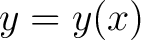
Let's derive the equation  $y = y(x)$  of this curve, called the catenary, in its plane with $x$-axis horizontal and $y$-axis vertical.  We denote the line density of the weight of the wire by $\sigma$.

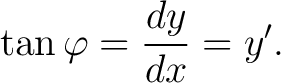
In any point  $(x,\,y)$  of the wire, the tangent line of the curve forms an angle $\varphi$ with the positive direction of $x$-axis.  Then,

$\displaystyle \tan\varphi = \frac{dy}{dx} = y'.$
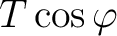
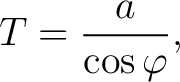
In the point, a certain tension $T$ of the wire acts in the direction of the tangent; it has the horizontal component  $T\cos\varphi$  which has apparently a constant value $a$.  Hence we may write

$\displaystyle T = \frac{a}{\cos\varphi},$
whence the vertical component of $T$ is

$\displaystyle T\sin{\varphi} = a\tan{\varphi}$
and its differential

$\displaystyle d(T\sin{\varphi}) = a\,d\tan{\varphi} = a\,dy'.$
But this differential is the amount of the supporting force acting on an infinitesimal portion of the wire having the projection $dx$ on the $x$-axis.  Because of the equilibrium, this force must be equal the weight  $\sigma\sqrt{1+(y'(x))^2}\,dx$ (see the arc length).  Thus we obtain the differential equation
$\displaystyle \sigma\sqrt{1+y'^2}\,dx = a\,dy',$ (1)
which allows the separation of variables:

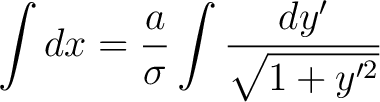
$\displaystyle \int dx = \frac{a}{\sigma}\int\frac{dy'}{\sqrt{1+y'^2}}$
This may be solved by using the substitution

$\displaystyle y' := \sinh{t}, \quad dy' = \cosh{t}\,dt, \quad \sqrt{1+y'^2} = \cosh{t}$
giving

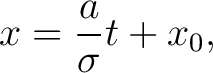
$\displaystyle x = \frac{a}{\sigma}t+x_0,$
i.e.

$\displaystyle y' = \frac{dy}{dx} = \sinh\frac{\sigma(x-x_0)}{a}.$
This leads to the final solution

$\displaystyle y = \frac{a}{\sigma}\cosh\frac{\sigma(x-x_0)}{a}+y_0$
of the equation (1).  We have denoted the constants of integration by $x_0$ and $y_0$.  They determine the position of the catenary in regard to the coordinate axes.  By a suitable choice of the axes and the measure units one gets the simple equation
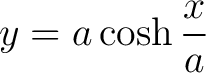
$\displaystyle y = a\cosh\frac{x}{a}$ (2)
of the catenary.

Some properties of catenary

  • $\tan\varphi = \sinh\frac{x}{a}, \quad \sin\varphi = \tanh\frac{x}{a}$
  • The arc length of the catenary (2) from the apex  $(0,\,a)$  to the point  $(x,\,y)$  is   $a\sinh\frac{x}{a} = \sqrt{y^2-a^2}$.
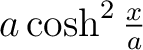
  • The radius of curvature of the catenary (2) is  $a\cosh^2\frac{x}{a}$, which is the same as length of the normal line of the catenary between the curve and the $x$-axis.
  • The catenary is the catacaustic of the exponential curve reflecting the vertical rays.
  • If a parabola rolls on a straight line, the focus draws a catenary.
  • The involute (or evolvent) of the catenary is the tractrix.


Anyone with an account can edit this entry. Please help improve it!

"catenary" is owned by pahio.
(view preamble)
View style:
Other names:  chain curve

This object's parent.

Cross-references: catacaustic, position, separation of variables, differential equation, equilibrium, system, function, graph
There are 2 references to this object.

This is version 1 of catenary, born on 2009-04-13.
Object id is 639, canonical name is Catenary.
Accessed 2683 times total.

Classification:
Physics Classification45. (Classical mechanics of discrete systems)
Pending Errata and Addenda
None.
Discussion
Style: Expand: Order:

No messages.

Interact
rate | post | correct | update request | add example | add (any)