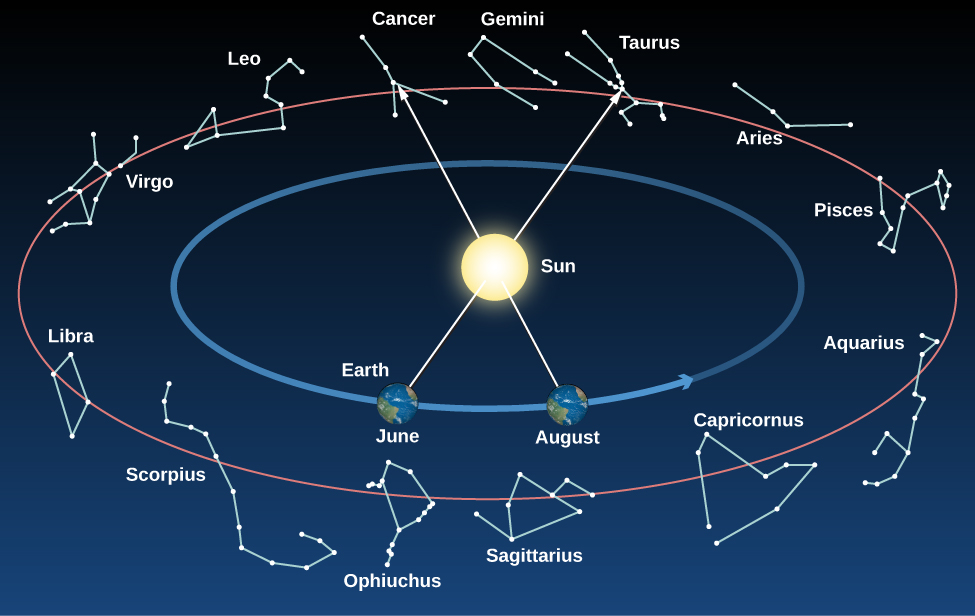
As Earth revolves around the Sun, we sit on ”platform Earth” and see the Sun moving around the
sky. The circle in the sky that the Sun appears to make around us in the course of a year is called
the ecliptic. This circle (like all circles in the sky) goes through a set of Constellations. The
ancients thought these constellations, which the Sun (and the Moon and planets) visited, must be
special and incorporated them into their system of astrology. Note that at any given
time of the year, some of the constellations crossed by the ecliptic are visible in the
night sky; others are in the day sky and are thus hidden by the brilliance of the Sun.
Figure 1. Constellations on the Ecliptic.
As the months go by and we look at the Sun from different places in our orbit, we see it projected
against different places in our orbit, and thus against different stars in the background (Figure and
Table) or we would, at least, if we could see the stars in the daytime. In practice, we
must deduce which stars lie behind and beyond the Sun by observing the stars visible
in the opposite direction at night. After a year, when Earth has completed one trip
around the Sun, the Sun will appear to have completed one circuit of the sky along the
ecliptic.
Constellation on the Ecliptic
Dates When the Sun Crosses It
Capricornus
January 21 - February 16
Aquarius
February 16 - March 11
Pisces
March 11 - April 18
Aries
April 18 - May 13
Taurus
May 13 - June 22
Gemini
June 22 - July 21
Cancer
July 21 - August 10
Leo
August 10 - September 16
Virgo
September 16 - October 31
Libra
October 31 - November 23
Scorpius
November 23 - November 29
Ophiuchus
November 29 - December 18
Sagittarius
December 18 - January 21
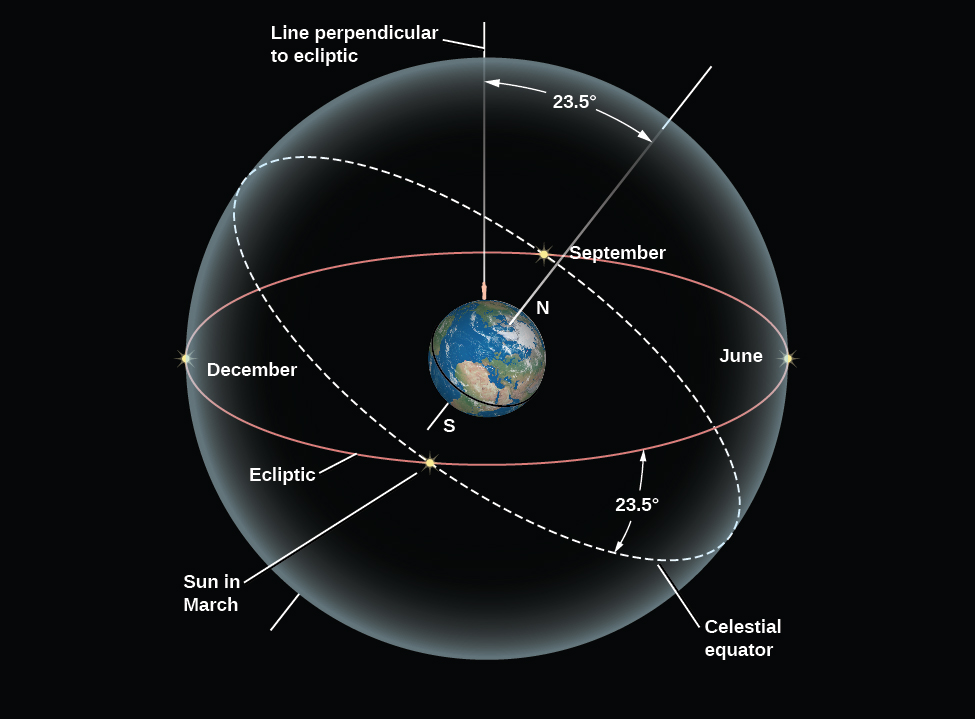
The ecliptic does not lie along the Celestial Equator but is inclined to it at an angle of about 23.5∘.
In other words, the Sun’s annual path in the sky is not linked with Earth’s equator. This is because
our planet’s axis of rotation is tilted by about 23.5∘ from a vertical line sticking out of the plane of
the ecliptic (Figure 2). Being tilted from ”straight up” is not at all unusual among celestial bodies;
Uranus and Pluto are actually tilted so much that they orbit the Sun ”on their side.”
The inclination of the ecliptic is the reason the Sun moves north and south in the sky as the
seasons change. In Earth, Moon, and Sky, we discuss the progression of the seasons in more detail.
Figure 2. The Celestial Tilt. The celestial equator is tilted by 23.5∘to the ecliptic. As a result,
North Americans and Europeans see the Sun north of the celestial equator and high in our sky in
June, and south of the celestial equator and low in the sky in December.
This article is a derivative work of the creative commons share alike with attribution in
[1].
References
[1] Fraknoi, Andrew, David Morrison, and Sidney Wolff. The Sky Above. In Astronomy
2e. Houston, Texas : OpenStax, 2022. The Sky Above
"Constellations on the Ecliptic" is owned by bloftin.
This is version 5 of Constellations on the Ecliptic, born on 2025-02-23, modified 2026-09-17.
Object id is 941, canonical name is ConstellationsOnTheEcliptic.
Accessed 2218 times total.